Ideas, collaboration, and lots of coding at the 2nd NGT Hackathon
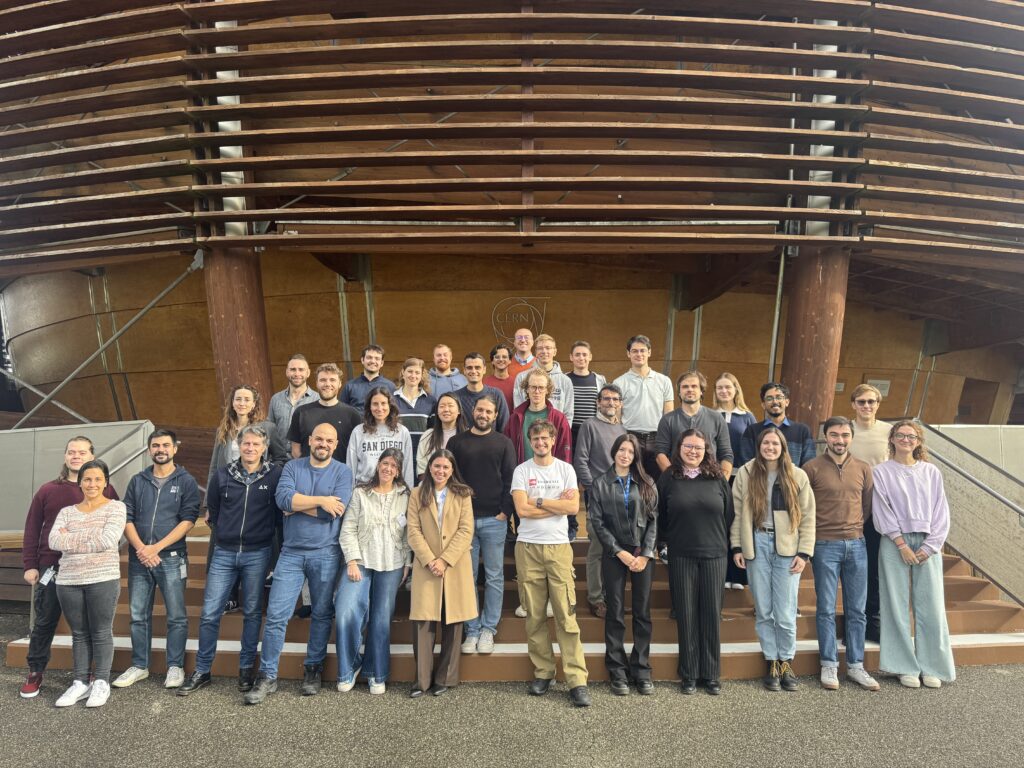
From 20 to 24 October 2025, more than 40 participants from NGT CMS, ATLAS, and other NGT work packages gathered at CERN’s IdeaSquare for the second edition of the NGT Hackathon — a week-long collaborative event designed to spark ideas, test solutions, and explore new directions for the future of trigger systems for the upcoming High-Luminosity LHC.
Building on the success of the first NGT Hackathon held in 2024, this second edition once again brought together engineers, physicists, and data scientists from diverse technical backgrounds to collaborate face-to-face on shared challenges and creative problem-solving.
Unlike traditional meetings, the hackathon format encourages hands-on work and spontaneous exchange — a space to brainstorm, code, and prototype away from emails, slides, and formal sessions. Participants formed small working groups around key topics proposed within the NGT programme, each contributing their expertise to technical developments across experiments and tasks.
Watch the video below to hear participants introduce their topics:
Working Topics
This year’s hackathon featured a diverse set of focus areas, from machine learning applications to advanced geometry modelling and workflow orchestration. Participants explored:
- ML for PUPPI in the Correlator Trigger
- MLOps
- Particle Flow Taus in the L1T Scouting workflow
- Extending the extension: including OT forward disk in the CA algorithm
- Job orchestration systems for optimal calibrations (Luigi & CMS Automation Framework)
- Common graph definition for CPU and GPU applications
- Detray GPU geometry
- Feasibility study of the ACTS Framework for CMS Phase-2 track reconstruction
Throughout the week, participants brainstormed solutions, ran tests, and exchanged ideas across experiments and work packages — strengthening the collaborative spirit that defines the NGT project.
As with every NGT initiative, the hackathon demonstrated how collaboration across communities — from hardware to software, from ATLAS to CMS — continues to drive the next generation of trigger technologies forward.